

By Business Insider Reporter
The Tanzania Bureau of Standards (TBS) has outlined a string of achievements recorded over the past four years under the sixth-phase government, with its Director General, Dr. Ashura Katunzi, declaring that the agency has grown into a nationally trusted and internationally recognised institution.
Speaking at a press briefing in Dar es Salaam today, Dr. Katunzi said the reforms and investments made have cemented TBS’s role in safeguarding quality, protecting consumers, and enabling trade.
She highlighted six major areas where the agency has made strides: expanding services, facilitating business, strengthening laboratories, leveraging ICT systems, supporting clean energy adoption and earning international recognition.

Expanding services closer to citizens
Dr. Katunzi said TBS has significantly extended its reach to ensure citizens across Tanzania can access services conveniently.
The agency has embarked on the construction of state-of-the-art laboratories in Dodoma and Mwanza, at a combined cost of TSh 36.8 billion.
Once complete, the Dodoma facility will serve the central regions of Dodoma, Singida and Tabora, while Mwanza will cover six Lake Zone regions including Kagera, Mara and Geita.
In addition, plans are underway for a laboratory and office complex in Arusha.
“These investments bring services closer to wananchi, reduce costs, and speed up sample testing,” she said.
TBS has also strengthened its nine zonal offices and 20 border posts, including Tunduma, Namanga, Rusumo and Julius Nyerere International Airport, through an injection of TSh 9.8 billion.
This expansion, according to Dr. Katunzi, has enhanced routine inspections, improved staffing levels, and supplied modern equipment to curb the flow of substandard goods into the market.
Facilitating trade, empowering entrepreneurs

A cornerstone of TBS’s work has been enabling businesses to thrive by setting and enforcing standards.
Over the past four years, the bureau developed 2,765 new standards across multiple sectors, from food and chemicals to engineering and mining.
These standards, created in consultation with 115 technical committees, aim to align Tanzanian products with global requirements.
To date, 3,184 quality certificates and licences have been issued, benefitting more than 1,300 small-scale entrepreneurs.
Notably, TBS allocates over TSh 350 million annually to subsidise certification costs for small businesses.
Efforts to secure safer markets include the registration of 8,199 food and cosmetic products and 47,886 production and sales premises.
Import controls have also intensified: 153,159 consignments were inspected before shipment, 352,103 consignments were checked on arrival, and 203,689 used vehicles underwent compliance testing.
Beyond regulation, TBS has invested in capacity building. More than 5,400 stakeholders, including processors and manufacturers, received training on quality standards, while an additional 1,000 food producers in 10 regions benefitted from the Qualitan project in partnership with SIDO.
Public education campaigns have been rolled out through exhibitions, seminars, community radios, and national media.
Strengthening laboratory efficiency
With 12 accredited laboratories, TBS now guarantees internationally recognised results.
Over the review period, more than 152,000 samples were tested and 43,000 measuring instruments calibrated.
Government investment worth TSh 12.9 billion has equipped labs with cutting-edge technology.
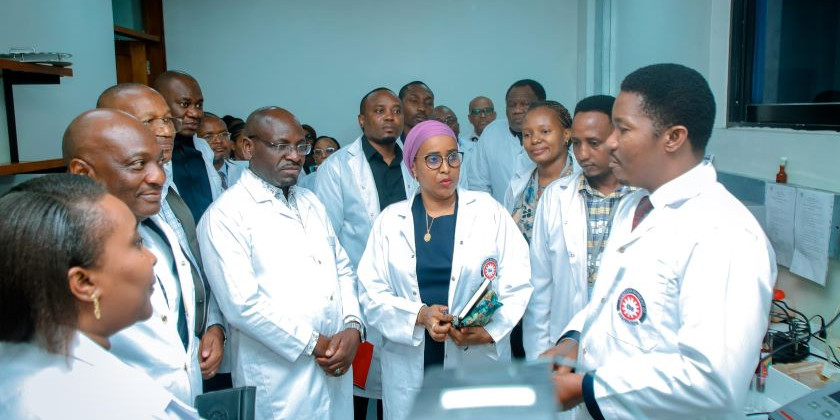
Among them are Africa’s few hydrostatic pressure testers for water pipes, a digital conductor resistance tester for power cables, and East Africa’s only solar simulator for testing solar panels independent of sunlight. “These facilities ensure Tanzanian products meet global benchmarks and give confidence to investors and consumers alike,” said Dr. Katunzi.
Leveraging ICT systems
Digital transformation has modernised TBS operations. Key systems include the Online Application System (OAS) and the Integrated Standards, Quality, Metrology and Testing System (i-SQMT).
These platforms enable traders to apply for licences, register products, and track consignments online.
Moreover, integration with the Tanzania Electronic Single Window System (TeSWS) has streamlined import procedures, allowing traders to obtain approvals from multiple agencies in one step. “This has reduced bureaucracy and cut the time and cost of doing business,” Dr. Katunzi explained.

Supporting Clean Cooking Energy strategy
In line with national climate and health goals, TBS has been central in promoting the adoption of clean cooking solutions.
Working with the Ministry of Energy and development partners, the bureau has developed efficiency standards for household electrical appliances and invested in laboratory tools to test compliance.
“This initiative reduces greenhouse gas emissions, cuts energy losses, and lowers household costs, while safeguarding public health and the environment,” Dr. Katunzi noted.
International recognition and awards
TBS’s work has not gone unnoticed internationally. In 2023, the agency won the coveted African Regulator of the Year award.
A year later, it became the first institution in the Southern African Development Community (SADC) to secure wide-scope accreditation for product certification systems under SADCAS.
This year, TBS also achieved accreditation for the updated ISO 22003:2022 food safety management standard, making it the first in SADC to reach that milestone.
Its experts are regularly seconded by SADCAS to support accreditation work across the region, while a young TBS officer scooped the ISO Next Generation Award in 2023 from among 175 member countries.
“These awards reflect our commitment to excellence, innovation, and professionalism. They also confirm that Tanzania’s quality infrastructure is now globally respected,” said Dr. Katunzi.
Looking ahead
Dr. Katunzi concluded by thanking President Samia Suluhu Hassan and the government for continued support, which has enabled TBS to “shine nationally and internationally.” She reaffirmed the bureau’s mission to drive industrialisation and protect consumers through standards and quality assurance.
“As we look to the future, TBS remains committed to expanding services, empowering businesses, and ensuring Tanzania’s products can compete confidently anywhere in the world,” she said.


