

By Business Insider Reporter
China’s slowing economy is no longer a distant concern for Africa.
A new Atlantic Council report, “China’s Economic Slowdown and Spillovers to Africa,” shows how weakening demand, shifting growth priorities, and tightening capital flows in Beijing are beginning to ripple across the continent.
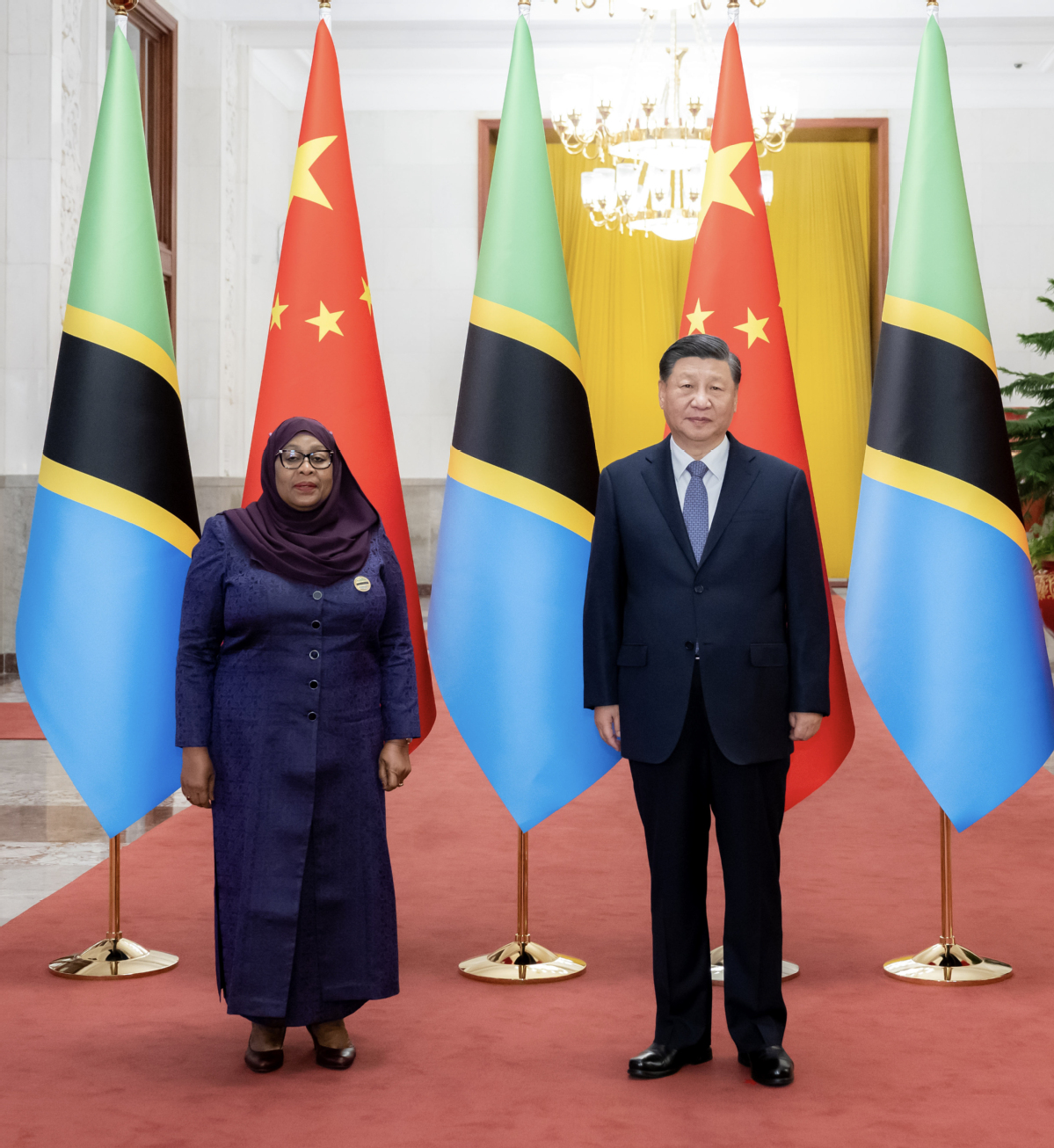
For Tanzania – one of China’s most important trading and investment partners in Sub-Saharan Africa – these shifts carry both risks and urgent lessons.
The report explains that China’s economic deceleration affects Africa primarily through trade and financial channels. Tanzania is deeply connected on both fronts, and the pace of recent engagement illustrates the scale of potential vulnerability.
In 2024, bilateral trade between the two countries reached a record US$8.88 billion, marking nine consecutive years of China’s dominance as Tanzania’s largest trading partner. By mid-2025, trade had already crossed US$4.1 billion, reflecting the enduring momentum of the relationship.
Tanzania’s exports – dominated by soybeans, sesame, avocados, cashews, and other agricultural goods – are increasingly tied to Chinese consumption trends, while imports from China continue to consist largely of machinery, electronics, transport equipment, and consumer goods.
While this relationship has supported Tanzania’s industrial and commercial growth, it has also entrenched a structural trade imbalance that leaves the country exposed to even minor shifts in Chinese demand.
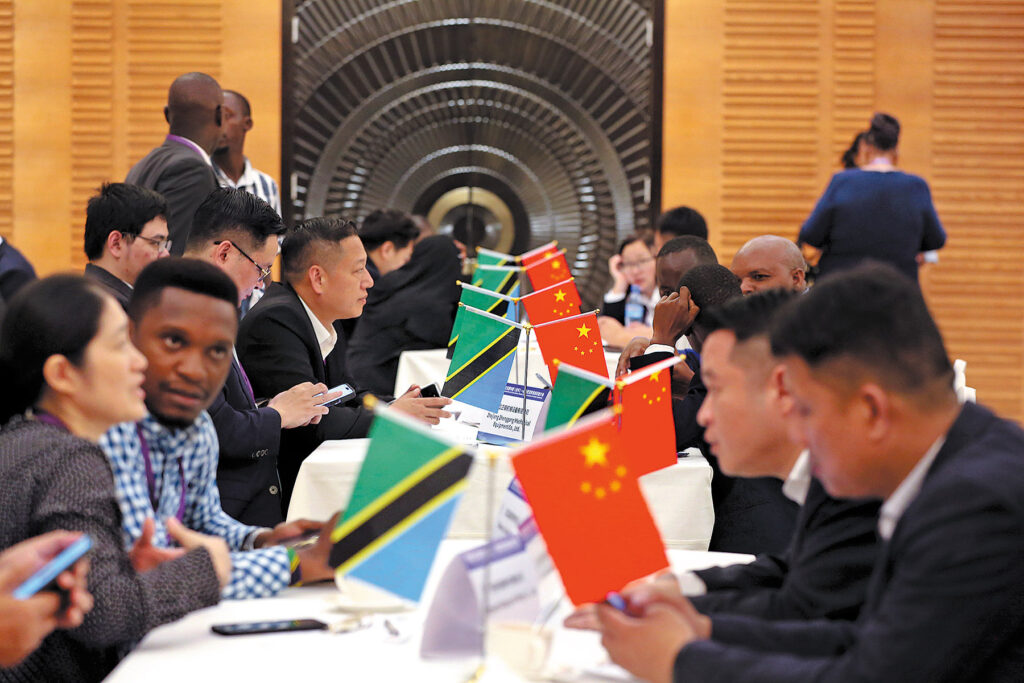
Investment ties run just as deep. By early 2024, the Tanzania Investment Centre reported more than 1,270 Chinese-registered projects valued at about US$11.4 billion, with the capacity to generate nearly 150,000 jobs.
Chinese companies are embedded in key national undertakings – from the Standard Gauge Railway and major hydropower structures to bridge construction and manufacturing hubs producing ceramics, float glass, and other industrial goods. These investments have become integral to Tanzania’s development pathway, enabling technology transfer, industrial capacity, and large-scale infrastructure expansion.
It is precisely this level of integration that makes Tanzania sensitive to the emerging global turbulence. The Atlantic Council report warns that as China slows and shifts away from heavy industry toward a more consumption-driven, services-oriented model, demand for the agricultural and raw material exports that many African economies depend on is likely to weaken.
For Tanzania, a decline in Chinese demand or falling commodity prices would directly affect export revenues, particularly in agriculture. Moreover, a deceleration in Chinese outward investment – an outcome the report argues is likely under all modeled scenarios – may place key infrastructure projects at risk, potentially delaying implementation, shrinking financing envelopes, or shifting project terms in ways that could challenge Tanzania’s fiscal planning.
At the same time, the report’s broader analysis places Tanzania’s situation within a continental context. It notes that Africa’s most China-dependent economies – those reliant on commodity exports or Chinese financing – are likely to feel the sharpest shocks.
Major oil exporters such as Angola and Nigeria face some of the highest levels of exposure, as China’s long-term energy transition will steadily erode demand for imported fossil fuels. Other countries heavily integrated into Chinese-backed infrastructure financing, including Ethiopia and Kenya, may also struggle as Chinese lenders and contractors become more cautious and selective.
South Africa, Egypt, and Morocco – economies with deeper financial markets – face risks through capital markets and currency volatility, as slowing Chinese growth affects global investor sentiment.
Meanwhile, mineral exporters such as the Democratic Republic of Congo and Zambia may experience more complex outcomes: while China’s slowdown may curb overall commodity demand, its transition toward green technology could sustain or even increase demand for transition minerals such as cobalt, lithium, and copper.
The report argues that the degree to which these countries benefit will depend on governance quality, industrial planning, and the ability to add value locally rather than exporting raw ores.
Across the continent, the report suggests that China’s slowdown exposes Africa to three main spillover pressures: weakening demand for commodities, declining Chinese development finance, and more volatile financial flows.
Because many African economies have built new infrastructure, manufacturing zones, and trade corridors around Chinese partnerships, the contraction of Chinese capital and the redirection of its economic model will force governments to rethink planning assumptions and diversify both markets and financing sources.
Even African countries with limited direct exposure to China may feel the impact through regional supply chains, shared infrastructure, and currency movements.
Still, the report emphasizes that opportunities exist alongside the risks. A China that grows more slowly but more sustainably could open space for African economies to develop new export niches, particularly in agriculture, manufacturing, and green-technology inputs.
But capitalizing on these opportunities requires investment in value-addition, stronger institutions, and deeper regional integration – as well as a clear understanding of how China’s internal reforms will redefine global economic patterns.
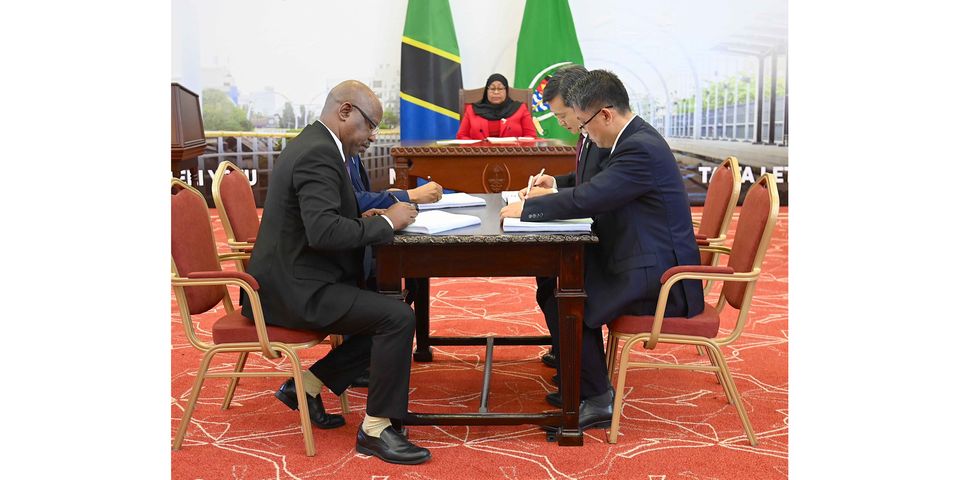
For Tanzania, these insights carry immediate implications. The country must prepare for a world in which China remains a key partner but may no longer be able to fuel infrastructure and industrial growth at previous levels.
This means doubling down on diversification – both of trade partners and financing sources – while strengthening domestic industries so they are less vulnerable to external shocks. Upgrading agricultural value chains, expanding manufacturing capacity, and attracting a broader mix of investors will help Tanzania maintain momentum even as Beijing recalibrates its global footprint.
Tanzania’s partnership with China has delivered enormous gains, from industrial growth to infrastructure transformation. But as Beijing shifts gears, Dodoma must chart its next moves with foresight and strategic discipline. The future of the relationship will depend not only on China’s trajectory but on Tanzania’s willingness to adapt, to innovate, and to position itself for an era in which global economic power – and the nature of Africa’s partnerships – is being fundamentally redefined.


